

Is Giftedness Neurodivergent? Why Context and Lived Experience Matter


Introduction
Questions about whether giftedness is neurodivergent often become trapped between two positions.
One position treats giftedness as automatically neurodivergent because it represents a departure from average cognitive ability. The other reduces giftedness to high intelligence, observes that intelligence is often socially valued, and concludes that giftedness cannot meaningfully be considered a form of neurodivergence.
Neither position adequately reflects the complexity or diversity of gifted people’s lives.
Giftedness is not a singular experience, and there is no universally accepted definition of it. It may refer to intellectual aptitude, creative capacity, unusual developmental potential, advanced achievement or a broader cognitive, emotional and perceptual profile. Contemporary giftedness literature increasingly recognises that there is no single “gifted prototype” and that gifted people’s profiles are heterogeneous, contextual and multidimensional (Baccassino & Pinnelli, 2023; Ronksley-Pavia, 2015).
A thoughtful conversation about giftedness and neurodivergence therefore cannot begin and end with the observation that some forms of intelligence are rewarded. It must consider how giftedness is lived, how social norms operate, whose intelligence is recognised, and what happens when a person’s ways of thinking and experiencing the world do not fit their environment.
The short answer: Is giftedness neurodivergent?
For some people, giftedness is meaningfully experienced as neurodivergence. It shapes the pace, depth and complexity of their cognition, their emotional and sensory world, their relationships, their identity and their interaction with neuronormative environments.
For others, giftedness may function primarily as an aptitude or educational classification and may not feel central to their identity or way of being.
There is no need to force every gifted person into the same category. However, the diversity of gifted experience is not a reason to categorically exclude giftedness from the neurodivergent umbrella. It is a reason to resist universal claims in either direction.
Giftedness is not simply another word for high intelligence
Reducing giftedness to intelligence creates a narrow and somewhat circular argument: intelligence is socially valued, giftedness is intelligence, and giftedness must therefore align with neuronormativity.
The first problem is that giftedness has never had one settled definition. Models of giftedness differ in whether they emphasise intellectual ability, creativity, aptitude, achievement, developmental potential, environmental opportunity or combinations of these factors. Even within education and psychology, gifted identification varies considerably across settings and research studies (Baccassino & Pinnelli, 2023; Ronksley-Pavia, 2015).
The second problem is that a measurable capacity does not necessarily capture how someone’s mind is organised.
For some gifted people, giftedness is not merely an ability to perform well on certain tasks. It may involve rapid and multilayered pattern recognition, complex associative thinking, an intense need for coherence, deep engagement with meaning, unusual intellectual curiosity and difficulty tolerating repetitive or insufficiently challenging environments.
It can affect not only what someone can do, but how they perceive, process and participate in the world. Removing “intelligence” from the wider person and assessing it as a detached trait can erase the configuration through which giftedness is actually experienced.
Minds are not flat-pack furniture. Taking them apart does not necessarily reveal how they function as a whole.
Social value is not the same as social acceptance
It is true that intelligence can provide social and material advantages. Certain forms of intellectual performance are rewarded within schools, universities and workplaces.
However, society’s selective use of intelligence is not the same as acceptance of gifted people.
Intelligence tends to be rewarded when it is:
productive and economically useful
measurable through approved systems
expressed without challenging existing power
packaged in socially comfortable communication
accompanied by consistent performance
modest enough not to unsettle others
A person may be celebrated for solving complex problems while being criticised for questioning an incoherent process. They may be praised for insight but described as intense when they explain their reasoning. They may be relied upon for their capacity while being denied support because their intelligence is assumed to protect them from disability, distress or burnout.
The ability is welcomed. The person is often expected to arrive with the inconvenient edges sanded away.
Research has documented the social stigma attached to giftedness for decades. Gifted adolescents may strategically conceal their abilities to preserve belonging, while stereotyped representations of gifted people can produce more negative attitudes towards them (Bergold et al., 2021; Cross et al., 1991). A recent study found that gifted students were not universally more socially distressed than their peers, but approximately one-third reported some degree of giftedness-related stigma. Those students reported weaker peer and teacher relationships, poorer social adjustment and a lower sense of belonging than gifted students who experienced little or no stigma (Carter et al., 2025). That finding captures the nuance needed here. Giftedness is not inevitably stigmatising, but neither is social acceptance guaranteed by intellectual capacity.

There is no singular gifted experience
Some gifted people grow up in families where their cognition is understood and mirrored. They receive appropriately challenging education, form relationships with people who share their interests and develop without being required to suppress significant parts of themselves.
Their giftedness may be affirming, well integrated and largely advantageous.
Others grow up without language for why they seem to think differently from those around them. They may experience chronic boredom, unmet educational needs, social alienation, perfectionistic expectations or pressure to reduce their intellectual and emotional intensity.
They may be simultaneously told that they are extraordinarily capable and that the way they express that capacity is excessive, arrogant or disruptive.
Still others may not be identified as gifted at all. Gifted identification is shaped by cultural expectations, socioeconomic access, race, language, disability and the methods institutions use to decide whose ability is visible. A study found that alternative identification methods could narrow some disparities affecting underrepresented students but did not eliminate inequity in gifted identification (Hodges et al., 2018).
These differing experiences are not contradictions requiring one side to be declared correct. They demonstrate that giftedness is relational.
The effects of a cognitive difference cannot be understood separately from the environments in which that difference develops, the resources available to the person and the meanings others attach to it.
Much as there is no single autistic or ADHD experience, there is no singular gifted experience.
Social construction does not mean lived experience becomes irrelevant
Understanding neurodivergence as socially constructed does not mean that neurocognitive experience is imaginary or unimportant.
It means that the boundaries between what is considered typical, different, disordered, gifted, capable or impaired are shaped through culture, institutions, language and power.
Social construction should invite more attention to lived experience, not less.
If neurodivergence is understood in relation to neuronormativity, we must ask who defines those norms. We must examine which forms of cognition are considered legitimate, whose differences are interpreted generously and whose accounts are treated as credible.
The neurodiversity paradigm has challenged autism research for focusing excessively on deficits, locating problems entirely within individuals and privileging narrow professional perspectives over autistic knowledge (Pellicano & den Houting, 2022).
It would be inconsistent to recognise these epistemic problems in relation to autism while making broad declarations about giftedness without substantially engaging with gifted people.
No one person’s story represents everyone. Lived experience is not a substitute for research, and research is not a substitute for lived experience. Each can reveal what the other misses. The ethical task is to bring them into conversation.
The stereotype of the universally privileged gifted person is harmful
One of the most persistent assumptions about gifted people is that they are inherently advantaged and therefore cannot have meaningful support needs related to their giftedness.
This stereotype can be harmful even when it sounds positive.
When gifted people are assumed to possess an all-purpose advantage, their difficulties may be interpreted as personal failures. Underachievement becomes wasted potential. Social disconnection becomes arrogance. Distress becomes evidence that they are ungrateful for their abilities.
This is not an argument that giftedness should be equated with disability, nor that gifted people are universally oppressed. It is an argument against treating privilege and marginalisation as mutually exclusive.
A person can hold intellectual, educational or professional privilege while also experiencing significant mismatch or stigma. Their capacities may grant access in one setting and intensify alienation in another. They may be highly competent in complex conceptual work while struggling with the consistency expected by conventional workplaces.
Social location is not a binary switch that makes someone either privileged or marginalised in every aspect of their life.
Multi-exceptionality cannot be divided into neat categories
The limitations of trait-by-trait reasoning become particularly visible in twice-exceptional and multi-exceptional experiences.
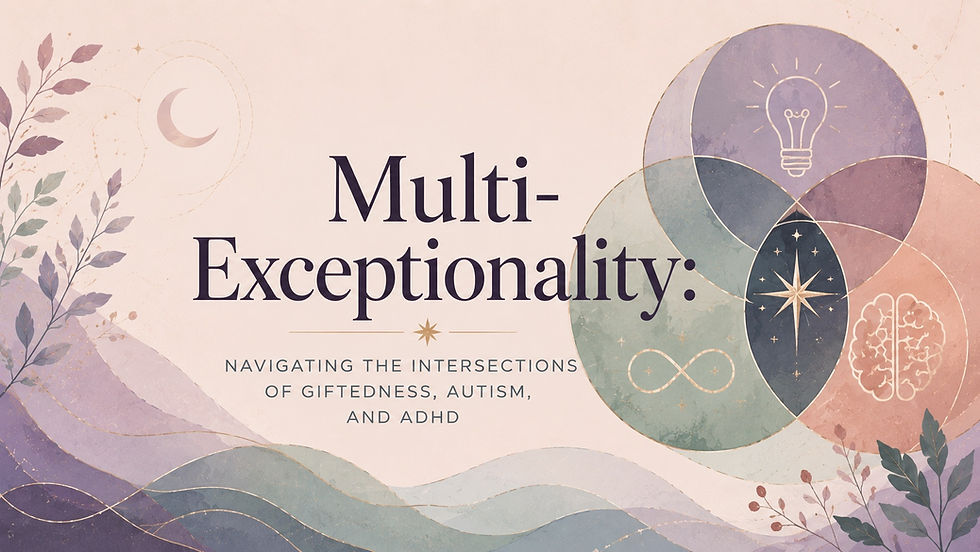
Twice-exceptionality refers to giftedness occurring alongside disability. Multi-exceptionality involves intersections among giftedness and multiple disabilities such as autism, ADHD and/or learning differences. These parts do not simply occupy separate rooms inside a person.
Research suggests that giftedness and co-occurring disability can conceal, compensate for, amplify or transform one another. A recent systematic review found that twice-exceptionality involves a complex and dynamic interaction in which some characteristics may be inhibited, others intensified and new patterns produced through their coexistence (Rizzo et al., 2025).
Giftedness may help an autistic or ADHD person:
rapidly analyse social environments
develop complex compensatory strategies
use language to conceal confusion or distress
achieve despite significant executive or sensory strain
understand expectations intellectually without those expectations becoming natural or sustainable.
At the same time, disability may obscure giftedness, particularly where ability is measured through consistent achievement, processing speed, classroom behaviour or conventional communication.
Neither side cancels the other.
Giftedness can facilitate masking while also being masked
In my own life, giftedness became part of the process through which I masked autism and ADHD.
It helped me observe patterns, analyse expectations, build elaborate social models and strategically navigate environments that did not naturally fit me. From the outside, this could look like effortless competence. Internally, it required constant monitoring and adjustment.
Yet giftedness was also something I learnt to hide.
Naming intellectual difference is often treated as a claim of superiority, particularly in an Australian cultural context where openly discussing giftedness may attract accusations of arrogance or pretension. I was therefore required to use giftedness to conceal my differences while simultaneously concealing giftedness to maintain social safety.
This is not every gifted person’s experience. It is also not an experience that should be erased because it complicates a neat theoretical category.
A more contextual understanding of giftedness and neurodivergence
A more helpful position is not that all gifted people must identify as neurodivergent.
It is that giftedness is heterogeneous and may hold different meanings across people and contexts.
For some, giftedness describes an aptitude that is supported, positively integrated and not particularly central to identity.
For others, it is an organising aspect of cognition, emotion, sensory processing, creativity, relationships and meaning-making. It influences how they encounter neuronormative expectations and may contribute to masking, stigma, access needs and person-environment mismatch.
These possibilities can coexist.
Neurodivergence does not require universal disadvantage. A characteristic does not become neuronormative merely because it can be advantageous. Nor does being supported invalidate someone’s difference. Support may simply reduce the harm produced by mismatch.
We should be wary of positions that respond to the diversity of neurodivergent experience by building increasingly rigid entry gates.
The neurodiversity paradigm offers something richer: the possibility of understanding minds relationally, contextually and without assuming that difference must be either a tragedy or an uncomplicated gift.
Whose knowledge gets to count?
Ultimately, conversations about giftedness and neurodivergence are also conversations about epistemic authority.
Who is permitted to describe gifted experience? Whose account is considered evidence? Who gets to decide whether a person’s cognitive difference is meaningful enough to count?
Gifted people are not a monolith, and no single framework will capture everyone. That diversity should encourage intellectual humility rather than categorical exclusion.
We can acknowledge that some gifted people do not identify as neurodivergent while respecting those for whom giftedness is inseparable from their neurodivergent identity and lived experience.
We can recognise intellectual privilege without denying stigma.
We can examine social construction without losing sight of embodiment.
We can value research without speaking over the people whose lives it seeks to understand.
In trying to dismantle one restrictive box, we should take care not to quietly build another.
Want to Learn More? Listen to Divergent Dialogues Podcast!
Listen to Episode #17 Co-occurrence Series - Giftedness with Jennifer Harvey Sallin InterGifted
In this episode, Teena and Caitlin discuss giftedness with Jennifer Harvey Sallin founding director of InterGifted. We explore the inspiration behind a unique model of giftedness, highlighting its diverse manifestations and the significance of recognising giftedness as a form of neurodivergence. This conversation sheds light on the importance of self-understanding and mental health for individuals who are gifted. We delve into the nuanced discussion on the co-occurrence of giftedness with other neurodivergences, such as Autism and ADHD, and uncover strategies to ensure giftedness is acknowledged within neurodiversity-affirming discourse. We also touch on the cultural aspects of giftedness and address the specific support needs of gifted individuals. Don't miss this enlightening discussion that challenges conventional views and advocates for a more inclusive understanding of giftedness.
In this deeply resonant conversation, we explore how Gifted identity is shaped through mirroring, the profound importance of safe, attuned relationships, and the nuanced challenges of living as neurodivergent individuals in a world built for sameness. Together, we reflect on the journey of self-acceptance, the role of humour and play as relational tools, and the healing power of co-created spaces that honour difference. We dive into existential perfectionism and the ongoing dance between the pathology paradigm and the neurodiversity paradigm. This episode is a grounded, compassionate invitation to embrace your full self—with curiosity, courage, and community.
Key Themes Explored:
Authenticity & relational safety: how feeling seen supports nervous system regulation and deeper self-understanding.
Self-acceptance journeys: reframing the need for external validation and embracing curiosity when building connections across neurotypes.
Emotional safety for gifted folks: unpacking internalised shame and societal expectations, and finding joy in interests.
Humour as both shield and bridge: playfulness as a tool for navigating uncertain social terrain.
Living biculturally: straddling the pathology paradigm and neurodiversity paradigm as clinicians with lived experience.
In this episode, we’re joined by Sheldon Gay for a thoughtful conversation about Black neurodivergent experiences, giftedness, identity, and intersectionality.
Together, we explore how systems like education and mental health can misunderstand or overlook neurodivergent people, particularly when race and culture intersect with neurodivergence. Sheldon shares reflections from his own journey as a late-identified gifted Black man, including how bias, assumptions, and systemic barriers can shape who gets recognised, supported, or misunderstood.
We also talk about:
The impact of being misread in school and mental health systems
Masking, code-switching, and navigating safety
Why curiosity and genuine listening matter
The importance of understanding intersectional lived experiences
Setting boundaries in spaces not designed for your identity or neurotype
This conversation invites us to slow down, stay curious, and reflect on how we can create spaces where all neurodivergent people are truly seen in their full humanity.
Frequently asked questions
Is giftedness considered neurodivergent?
There is no universally agreed answer. Some people experience giftedness as an integral neurocognitive difference and identify it as part of their neurodivergence. Others experience it primarily as an aptitude and do not identify that way.
Is giftedness just having a high IQ?
No. Some models use intellectual testing as a key criterion, but giftedness has also been understood through multidimensional models involving creativity, aptitude, potential, achievement, development and environmental context.
Can gifted people experience stigma?
Yes, although experiences vary. Research has identified stereotypes, concealment strategies and reduced belonging among some gifted people. Other gifted people report positive or relatively ordinary social experiences.
What are twice-exceptionality and multi-exceptionality?
Twice-exceptionality describes the coexistence of giftedness with disability. Multi-exceptionality refers to giftedness alongside multiple co-occurring disabilities. These aspects of a person’s profile interact dynamically and may mask, compensate for, intensify or reshape one another.
Does identifying giftedness as neurodivergent mean it is a disorder?
No. Neurodivergence is not synonymous with disorder. It can describe ways of thinking, processing or experiencing that differ from socially dominant expectations, whether or not the person experiences them as disabling.
References
Baccassino, F., & Pinnelli, S. (2023). Giftedness and gifted education: A systematic literature review. Frontiers in Education, 7, Article 1073007. https://doi.org/10.3389/feduc.2022.1073007
Bergold, S., Hastall, M. R., & Steinmayr, R. (2021). Do mass media shape stereotypes about intellectually gifted individuals? Two experiments on stigmatization effects from biased newspaper reports. Gifted Child Quarterly, 65(1), 75–94. https://doi.org/10.1177/0016986220969393
Carter, S. S., Avci, A. H., & Mammadov, S. (2025). School experiences of gifted adolescents and their peers. Psychology in the Schools, 62(9), 3273–3284. https://doi.org/10.1002/pits.23537
Cross, T. L., Coleman, L. J., & Terhaar-Yonkers, M. (1991). The social cognition of gifted adolescents in schools: Managing the stigma of giftedness. Journal for the Education of the Gifted, 15(1), 44–55. https://doi.org/10.1177/016235329101500106
Georgiou, M., & Hughes, C. N. (2025). The dual path of unmasking multi-exceptionality and positive disintegration. Advanced Development, 20, 65–84. https://www.researchgate.net/publication/397860053_The_Dual_Path_of_Unmasking_Multi-Exceptionality_and_Positive_Disintegration
Hodges, J., Tay, J., Maeda, Y., & Gentry, M. (2018). A meta-analysis of gifted and talented identification practices. Gifted Child Quarterly, 62(2), 147–174. https://doi.org/10.1177/0016986217752107
Pellicano, E., & den Houting, J. (2022). Annual research review: Shifting from “normal science” to neurodiversity in autism science. Journal of Child Psychology and Psychiatry, 63(4), 381–396. https://doi.org/10.1111/jcpp.13534
Rizzo, L., Pinnelli, S., & Minnaert, A. (2025). Twice-exceptional students: A systematic review to outline the distinctive characteristics through a multidimensional lens. Frontiers in Education, 10, Article 1696805. https://doi.org/10.3389/feduc.2025.1696805
Ronksley-Pavia, M. (2015). A model of twice-exceptionality: Explaining and defining the apparent paradoxical combination of disability and giftedness in childhood. Journal for the Education of the Gifted, 38(3), 318–340. https://doi.org/10.1177/0162353215592499


Comments